Predict attitude
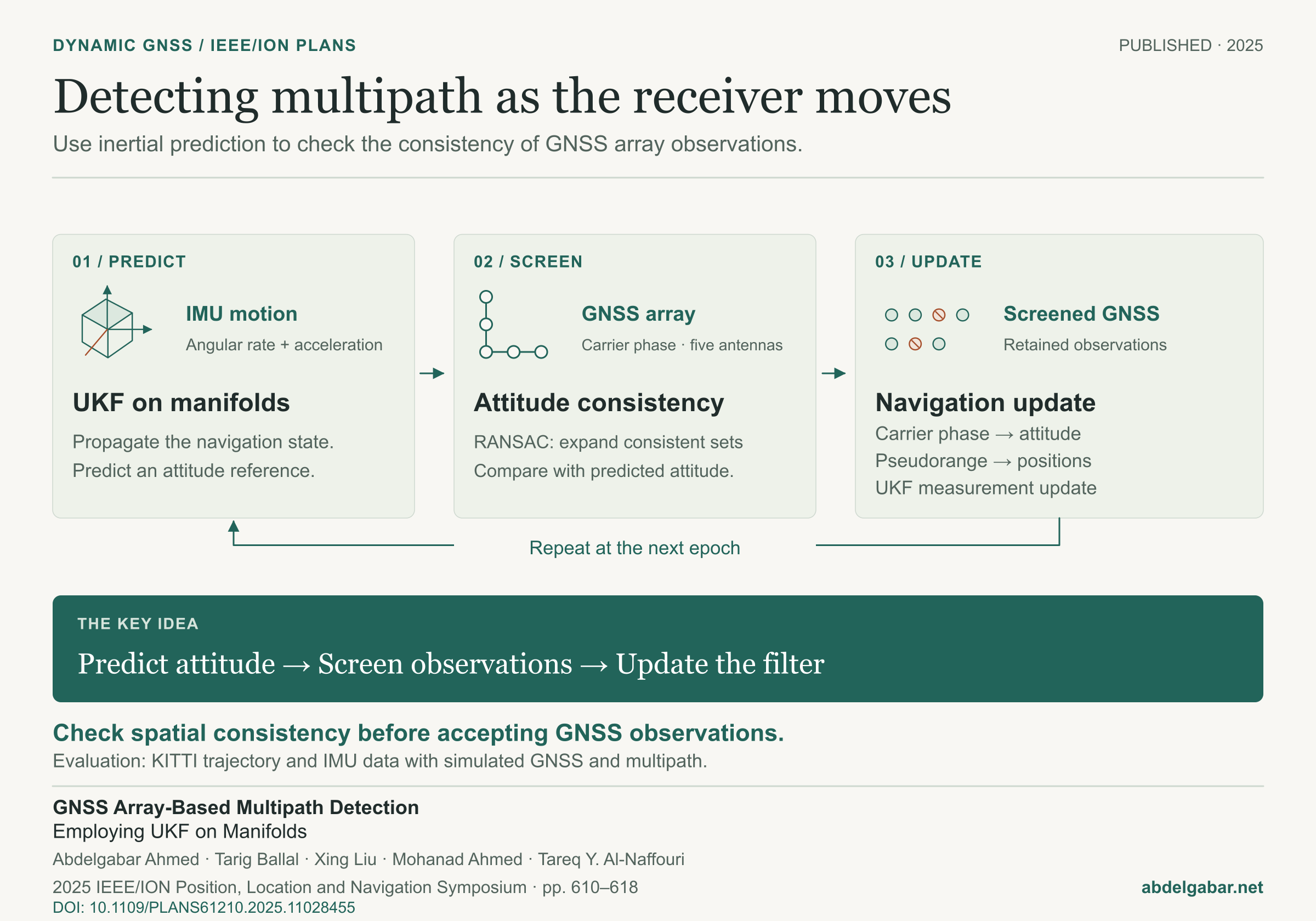
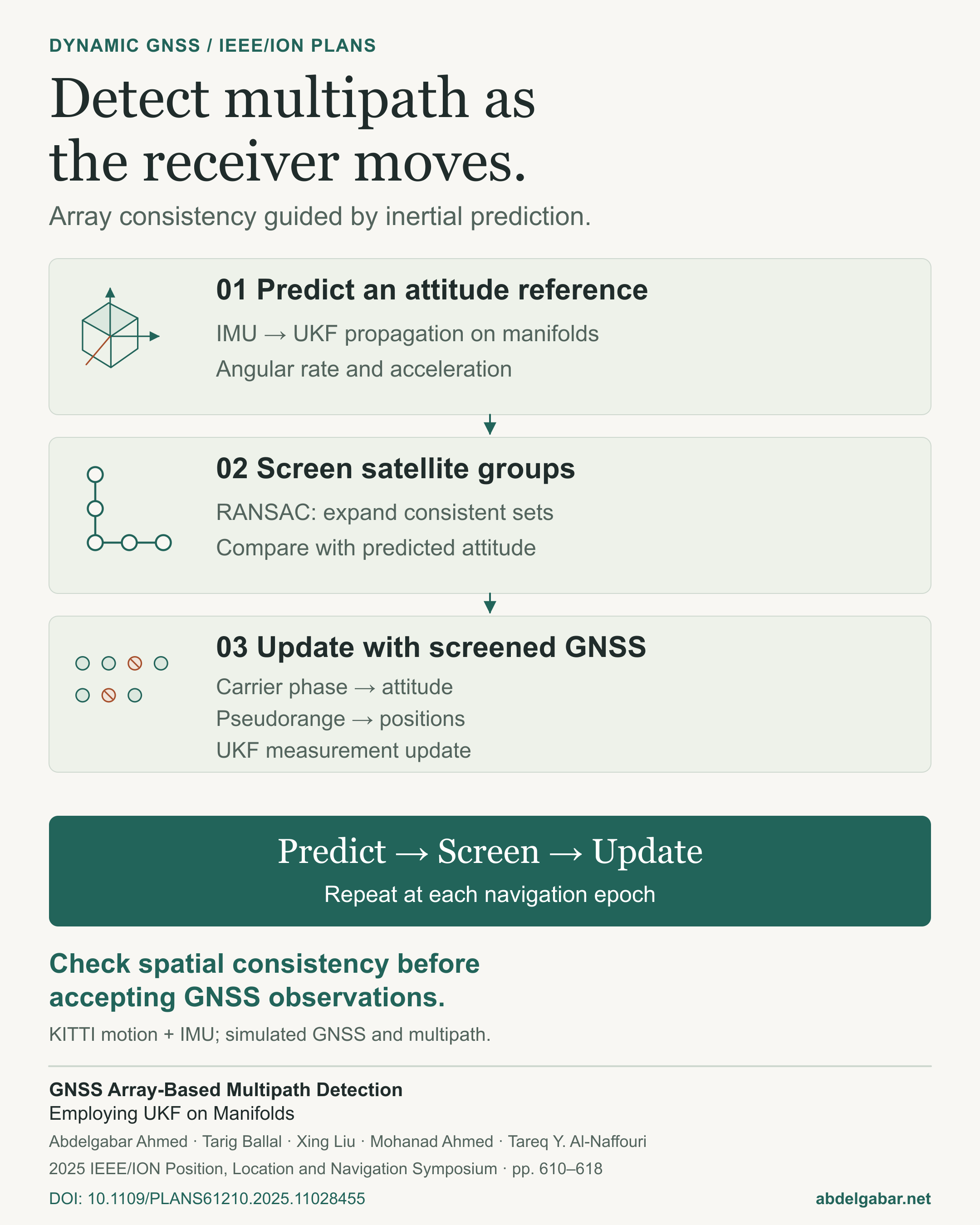
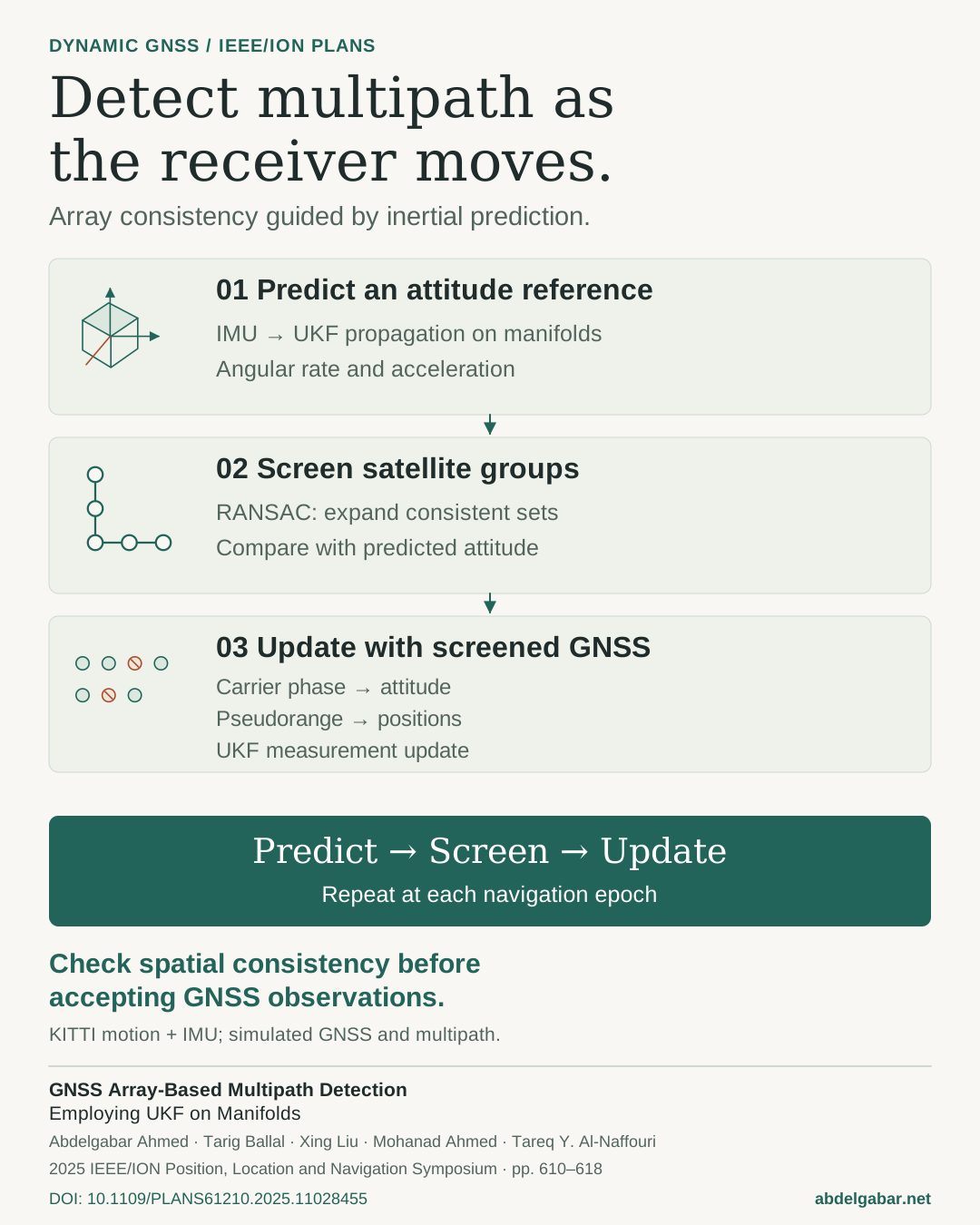
Gyroscope and accelerometer measurements propagate the UKF state and provide the attitude reference for screening. Attitude is represented on the rotation manifold SO(3).
Conference paper · Visual summary
A five-antenna GNSS array and an IMU support a repeating predict–screen–update loop. The UKF tracks attitude on a manifold; RANSAC tests carrier-phase-derived attitude consistency to select observations for the next position and attitude update.
The idea
Gyroscope and accelerometer measurements propagate the UKF state and provide the attitude reference for screening. Attitude is represented on the rotation manifold SO(3).
Estimate attitude from sampled carrier-phase subsets, expand internally consistent sets, and select a sufficiently large consensus closest to the predicted attitude. These are two separate consistency checks.
Use retained carrier phases for array attitude and pseudoranges for receiver positions, then update the UKF for the next epoch.
The predicted attitude guides satellite screening, and the selected observations feed the next filter update. The method requires at least four multipath-free satellites; errors in the reference attitude can propagate over time.
Static Monte Carlo tests use simulated GNSS observations and multipath. The moving scenario uses KITTI motion and IMU data with simulated GNSS observations and multipath. The reported improvements are simulation results; physical-receiver validation remains future work.
Conference paper Published
2025 IEEE/ION Position, Location and Navigation Symposium (PLANS) · pp. 610–618
28 April–1 May 2025 · Salt Lake Marriott Downtown at City Creek · Salt Lake City, Utah, USA
Presented 29 April 2025 · Session C1: Multisensor Integrated Systems and Sensor Fusion Technologies
Original explanatory artwork based on the paper’s GNSS array–IMU framework, RANSAC detector, and simulation study (Sections III–V).