Cache four-source geometry
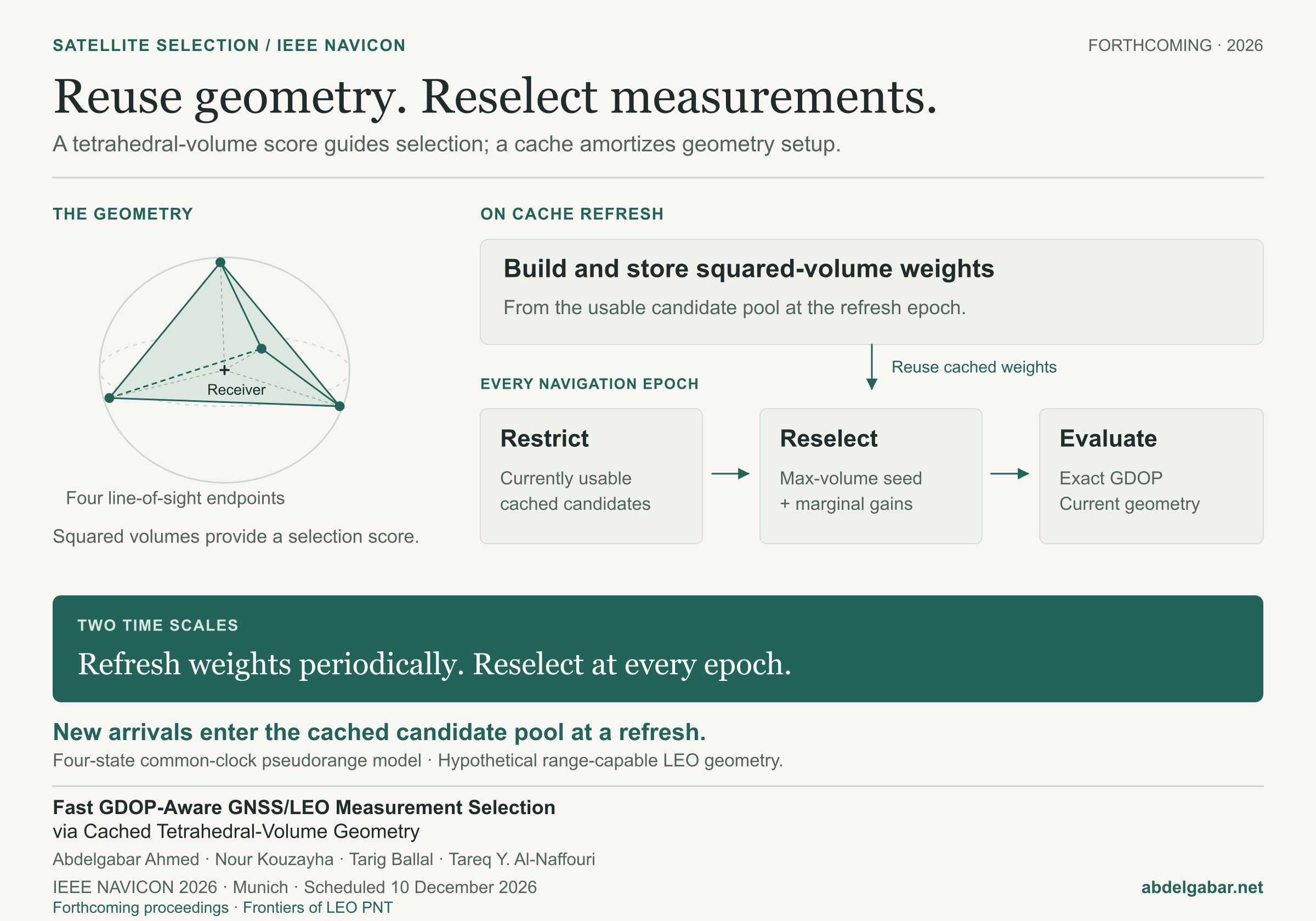
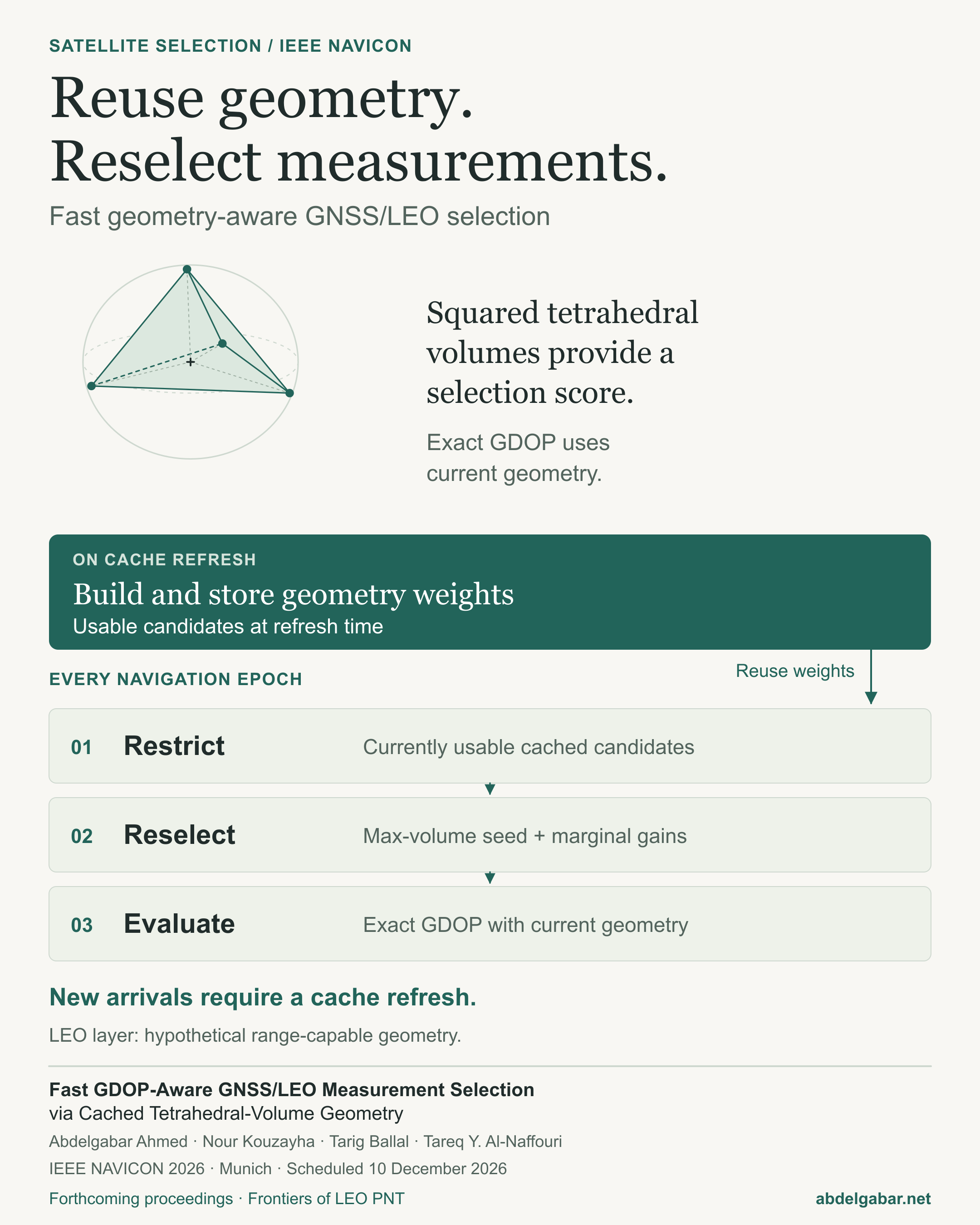
At each refresh, compute squared volumes for four-source combinations in the cached candidate pool. Reuse these weights between refreshes.
Forthcoming conference paper · Visual summary
Tetrahedral volumes formed by four satellite line-of-sight endpoints give reusable geometric scores. Volume-Greedy uses their marginal gains to select a compact measurement subset, while caching spreads the cost of building the score table across navigation epochs.
The idea
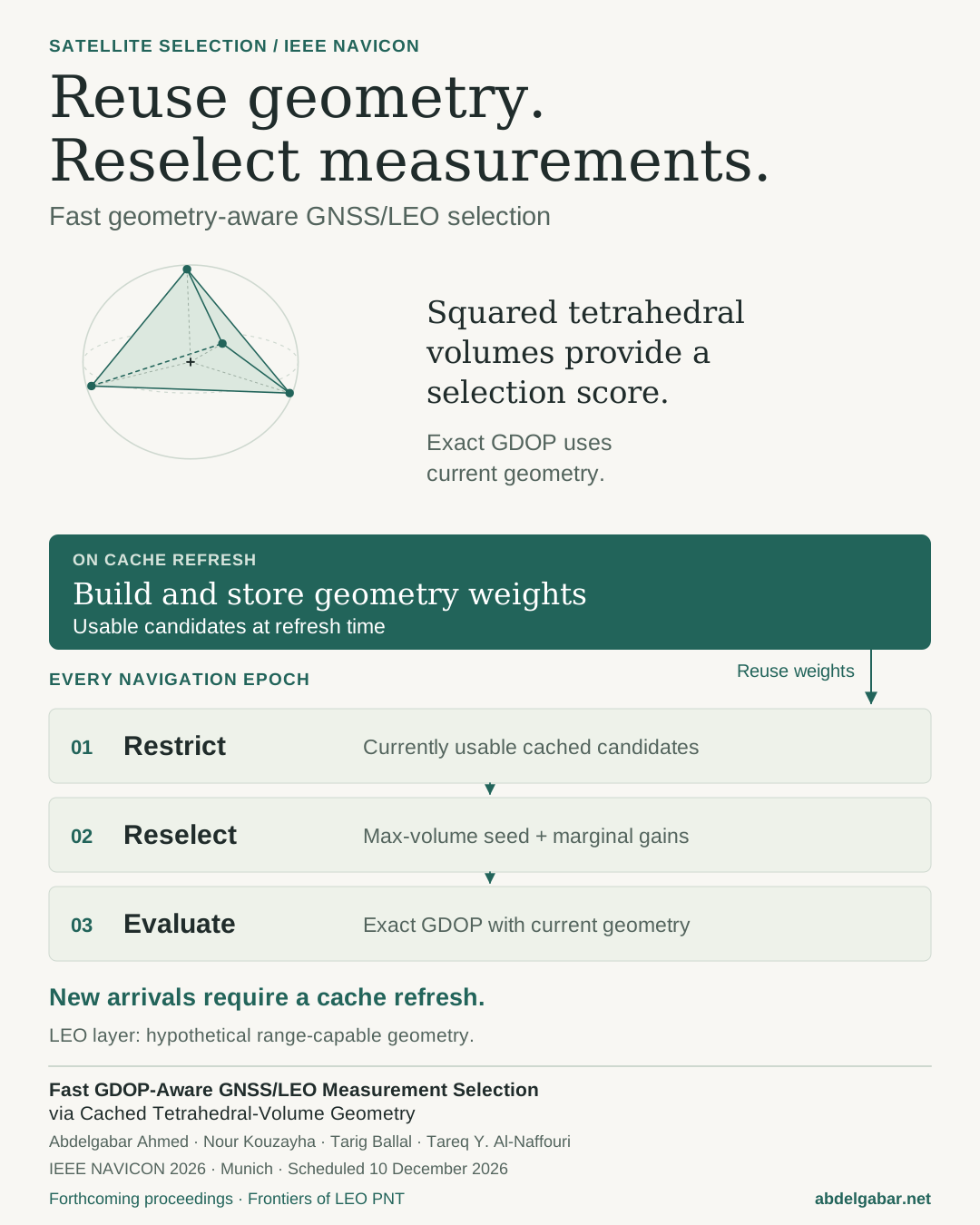
At each refresh, compute squared volumes for four-source combinations in the cached candidate pool. Reuse these weights between refreshes.
At every position, velocity and time (PVT) epoch, restrict selection to sources that are both currently usable and present in the cache. Start from a maximum-volume four-source seed and add sources by accumulated squared-volume gain.
Evaluate the final selected subset with exact geometric dilution of precision (GDOP) using the current line-of-sight geometry. This assessment uses current geometry even when selection weights come from an earlier refresh.
The cache stores geometry scores, rather than freezing the chosen measurements. Newly arrived sources enter the candidate set after a cache refresh. Under a common-clock, four-state, equal-variance pseudorange model, the volume score is proportional to the determinant of the normal matrix. It is a surrogate for GDOP-aware selection; the greedy procedure does not guarantee the exact GDOP optimum.
The study evaluates GNSS-only and hypothetical range-capable LEO-only geometry. The LEO experiment models geometry, rather than RF visibility or synchronized pseudorange access to present-day broadband LEO services.
Conference proceedings Forthcoming
Proceedings of the IEEE Navigation Conference (NAVICON 2026) · Munich, Germany
Scheduled for 10 December 2026 · Special session: Frontiers of LEO PNT
Original explanatory artwork based on the submitted paper’s tetrahedral-volume selector and rolling-cache method (Section III).